
Transfer slabs - useful information for principal accountable persons
Transfer slabs in buildings
This guide explains transfer slabs – a reinforced concrete structural element used in some buildings.
This information is aimed at principal accountable persons (PAPs) of higher risk buildings in England and follows BSR correspondence on the potential risks from transfer slabs in buildings published in December 2025 and an update to PAPs in February 2026.
We want to further explain the potential risk and provide advice on the steps you should take if you have one in your building.
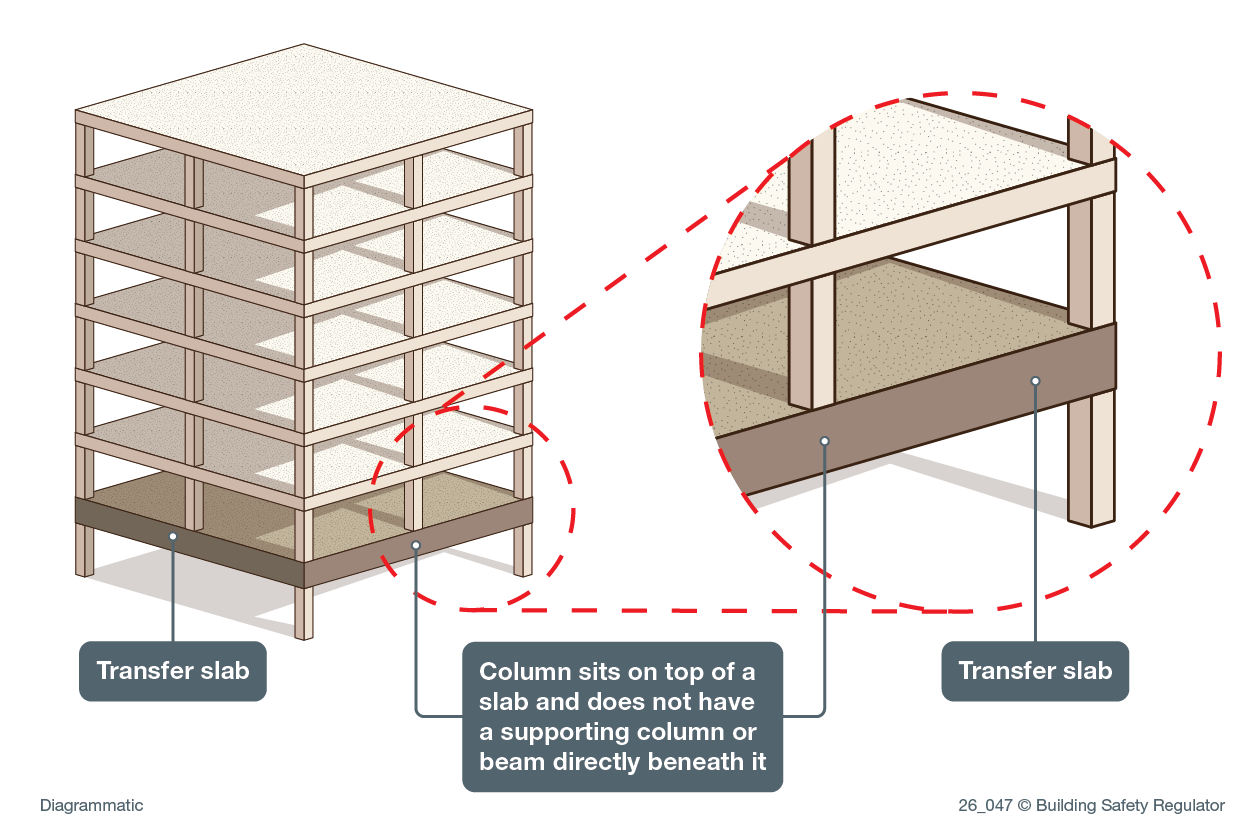
A transfer slab is used where a column sits on top of a slab but does not have a supporting column or beam directly beneath it.
The slab acts to support the load from the column and spreads it to the supporting columns below.
History of transfer slabs in construction
Transfer slabs have been used commonly in the UK for over 25 years in reinforced concrete buildings, particularly in mixed-use developments where the column grid changes between floors.
Not all construction of this nature will have issues.
Safety of transfer slabs
Most transfer slabs are likely to be adequate, but a potential issue which could cause a transfer slab to be unsafe has been identified.
This could in very rare instances lead to a column punching through a transfer slab. This “punching shear” failure could trigger a partial building collapse.
There have been recorded instances of localised structural distress at a small number of UK buildings featuring transfer slabs. These buildings required urgent works to help keep residents safe.
There have been no recorded incidents of this causing a building collapse in the UK to date.
Steps you should be taking
You should be identifying if your building has a transfer slab. If you do not know if your building has a transfer slab, you should consider consulting a buildings’ professional.
Those professionals include surveyors or structural engineers with a suitable level of expertise to advise on this issue.
Additional information for PAPs with identified transfer slabs
Signs PAPs should look for
While serious structural issues with transfer slabs are rare, PAPs can help by looking for any signs of building movement, such as:
- any cracks in a transfer slab (or a hard floor finish fixed directly to a transfer slab, for example tiling)
- cracks in columns and walls immediately above and/or below a transfer slab
- doors getting stuck in their frames in the levels immediately above transfer slabs
Certain types of cracking in concrete structures can be normal. However, PAPs should investigate and consider seeking specialist advice where such issues arise, to ensure they are properly assessed.
This also applies to concerns raised by residents living in the building.
Urgent advice should be sought if cracks are growing, or if new cracks appear.
Building changes
Change to a building’s structure or usage could increase the risk of a transfer slab failure.
For example, any:
- change in loading to the building on floors at or above the transfer slab level. This could happen if a floor’s usage changes
- building work which could weaken a transfer slab. For example, a new hole through a transfer slab for a pipe which could make a transfer slab less strong
- intrusive investigations into a transfer slab which involve drilling into or removing sections of concrete.
Before these types of changes begin, PAPs should ensure a competent structural engineer conducts a full check to make sure proposals are safe.
Building work must also comply with building regulations where applicable.
Your local authority Building Control department or a private registered building control approver will be able to advise you on the process to follow.
Worsening in condition
A transfer slab could become unsafe if its condition worsens. The most likely cause of this would be if water came into contact with a transfer slab over a long period of time.
This is because it could cause damage to the steel bars inside the concrete.
Most transfer slabs are located inside buildings where they rarely come into repeated contact with significant amounts of water.
Transfer slabs supporting car parks or extending outside the building footprint to support external areas either at ground floor or upper levels, are at higher risk of their condition worsening.
As part of your ongoing duty to manage building safety risks, we recommend you monitor the condition of your transfer slab closely if these conditions exist in your building.
You may want to consult a surveyor or a structural engineer with a suitable level of expertise to advise on this issue, to help you do this.
What steps PAPs should be taking
PAPs have an ongoing duty to always manage building safety risks (spread of fire and structural failure).
If you find or suspect transfer slabs, you must manage their safety risk. You may need advice from a competent structural engineer to help with this.
Your management of safety risks will be part of any future assessments of your building carried out by BSR.
PAPs have a legal duty to submit mandatory occurrence reports to BSR for some structural safety risks. This reporting system allows BSR to determine how severe the safety occurrence is and whether the risk is being managed.
PAPs must continue to follow their safety case plans, manage risks, and seek advice until new guidance is available.
We will provide further detailed advice on the assessment of the safety of transfer slabs in due course, and we ask that PAPs and building owners stay informed on this issue.
Keeping residents informed
PAPs and building owners should also look to inform and engage with residents about transfer slabs, if it is applicable to their building(s).
BSR has produced useful information aimed at residents here.
Other useful information
- Potential risks from transfer slabs in buildings – GOV.UK
- Design of transfer slabs – The Institution of Structural Engineers
- Transfer slabs in buildings: Advice and FAQs – Royal Institution of Chartered Surveyors (RICS)
- Role and responsibilities of accountable persons for HRBs
- Contact the Building Safety Regulator – GOV.UK
- Submitting mandatory occurrence notices and reports – GOV.UK
- BSR to introduce more proportionate and targeted approach for higher-risk building assessments – GOV.UK
Building safety guidance and resources
A to Z of building safety
Updates from the Building Safety Regulator
Keep up to date with the new regulator with our e-bulletin.