
Your Home, Your Safety
Transfer slabs – residents’ guide
The Building Safety Regulator (BSR) works to make sure residents in high-rise buildings feel safe and are safe in their homes.
The government established a new system, including the formation of BSR, to prevent tragedies like Grenfell Tower from ever happening again.
This guide explains ‘transfer slabs’ – a reinforced concrete structural element used in some buildings.
We want to explain the potential risk and provide advice on the steps you should take if you have one in your building.

Transfer slabs explained
A transfer slab is used where a column sits on top of a slab but does not have a supporting column or beam directly beneath it.
The slab acts to support the load from the column and spreads it to the supporting columns below.
Transfer slabs have been used commonly in the UK for over 25 years in reinforced concrete buildings, particularly in mixed-use developments where the column grid changes between floors.
Important: Not all construction of this nature will have issues.
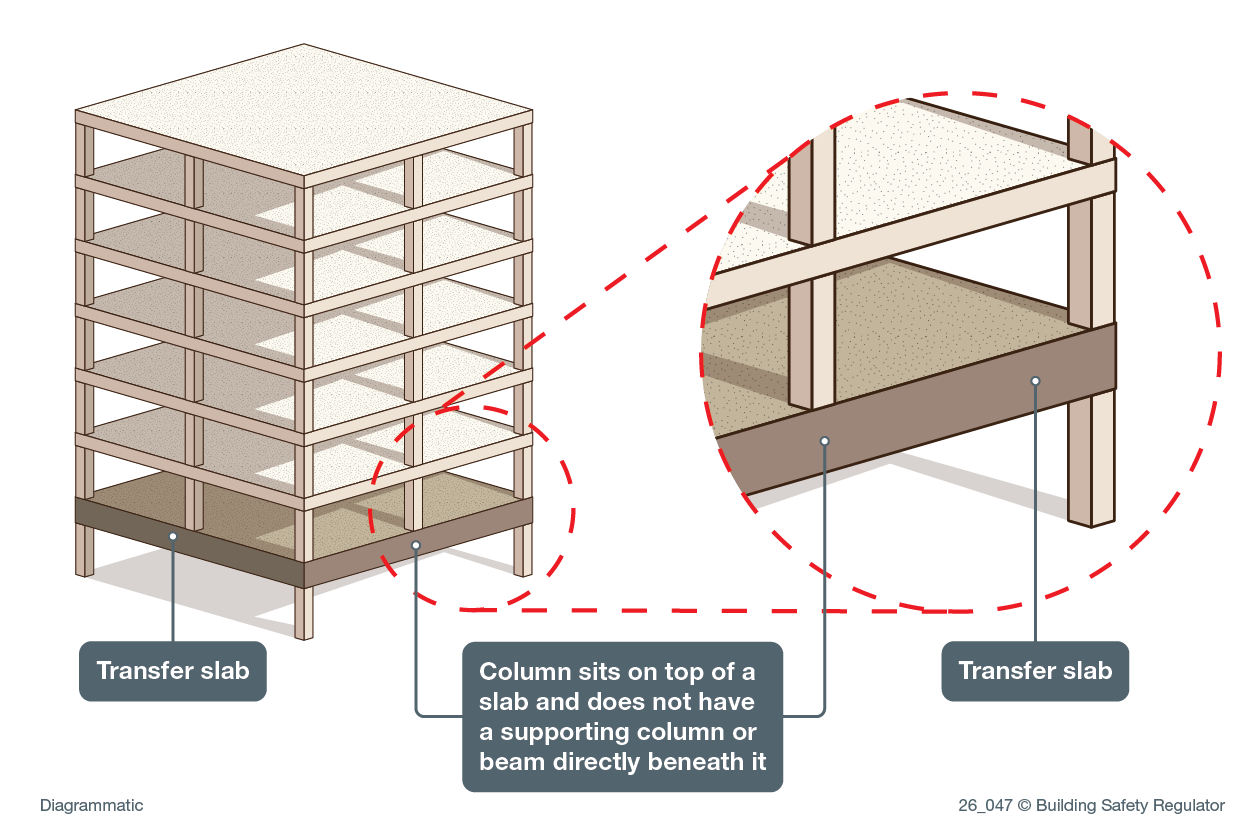
Safety of transfer slabs
A potential issue which could cause a transfer slab to be unsafe has been identified.
This could lead to a column punching through a transfer slab. This “punching shear” failure could trigger a partial building collapse.
There have been recorded instances of localised structural distress at a small number of UK buildings featuring transfer slabs. These buildings required urgent works to help keep residents safe.
Most transfer slabs are likely to be adequate when properly maintained. There have been no recorded incidents of this causing a building collapse in the UK to date.
How do I know if my building has a transfer slab?
The people or organisation responsible for your high-rise building’s safety are known as the ‘principal accountable person’ (PAP) or ‘accountable persons’ (APs).
Your principal accountable person should be able to tell you if your building has a transfer slab. In this guide we will call them a “PAP”.
If you don’t know who your building’s PAP is then ask your caretaker, concierge, building manager or landlord to give you their details or contact them on your behalf.
Residents with transfer slabs in their building
Signs residents should look for
PAPs are responsible for assessing and managing the risks posed to people from structural failure.
While serious structural issues with transfer slabs are rare, residents can help PAPs by looking for any signs of building movement, such as:
- any cracks in a transfer slab (or a hard floor finish fixed directly to a transfer slab, for example tiling)
- cracks in columns and walls immediately above and/or below a transfer slab
- doors getting stuck in their frames in the levels immediately above transfer slabs
If any of these issues are found, you should contact your PAP. Most issues will not be a serious safety concern, but your PAP should investigate them.
Having to move from your home
Finding a transfer slab does not mean you need to leave your home. You should only be relocated if the building is unsafe or potentially unsafe.
If a move is necessary for your safety:
- your landlord or building manager should explain exactly why and how long it will take
- they should help vulnerable residents and consider individual needs
- you should receive a full breakdown of all covered costs and expenses
Find out more: Temporary moves expectations – Housing Ombudsman
What steps should your PAP be taking?
Your PAP has an ongoing duty to always manage building safety risks (spread of fire and structural failure).
Where transfer slabs have been found, or are suspected, their safety risk should be managed.
Your PAP’s management of safety risks will be assessed by BSR when your building is part of any future building assessments.
Your PAP may have a legal duty to submit a “mandatory occurrence report” to the BSR if a significant safety risk is identified with a transfer slab.
This reporting system allows BSR to determine how severe the safety occurrence is and whether the risk is being managed.

Found this guide useful?
Why not share this page with other residents, your residents’ committee or on social media? You can also download a version to print at home, photocopy or have professionally printed:
Where can I find out more?
Talk to your PAP, building owner, manager, landlord or their managing agent. They are responsible for sharing information with you about your building’s safety.
Your caretaker or concierge should be able to contact them or give their details if you don’t have them.
Other useful information
- Potential risks from transfer slabs in buildings – GOV.UK
- Role and responsibilities of accountable persons for HRBs
- Contact the Building Safety Regulator – GOV.UK
- BSR to introduce more proportionate and targeted approach for higher-risk building assessments – GOV.UK
- Submitting mandatory occurrence notices and reports – GOV.UK
- Sign up for our free residents’ newsletter
- follow us on social media using the links below
A to Z of building safety
To find out more about any terms or organisations used on this page, refer to our A to Z of building safety glossary.