Planning Gateway One – five years on, signs of real progress
What is Planning Gateway One?
Planning Gateway One (PGO) will mark its fifth anniversary on 1 August 2026. Over that time, BSR has been providing fire safety advice to local planning authorities.
This advice has been helping to inform decisions on developments that include tall residential buildings.

Attention has understandably focused in recent years on building control and other parts of BSR’s work. However, PGO has continued to play an important role in improving the quality of fire safety thinking earlier in the design process.
And the picture emerging from that work is encouraging.
A clear downward trend in objections
One of the clearest signs of progress is the drop in the number of planning applications PGO has objected to on fire safety grounds.
The chart below shows the percentage of planning applications objected to each month between January 2022 and December 2025. In the earlier period, objections were made on up to 70% of applications.
Across 2022, BSR objected to an average of 57% of the planning applications it was consulted on.
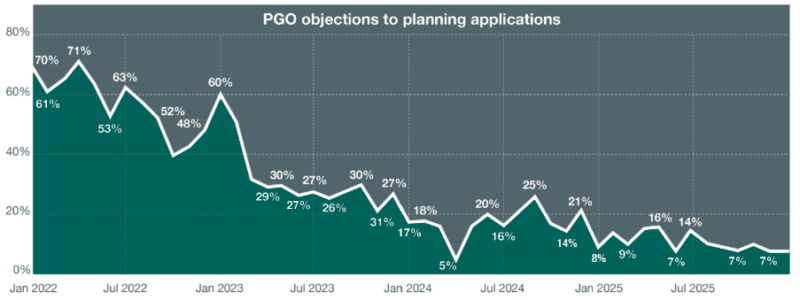
That is a significant change. While there is still more to do, fire safety design is increasingly being considered earlier and more seriously as part of the planning process. By contrast, in 2025 that figure had fallen to 10%.
Part of this improvement reflects changes in standards and guidance. But another, equally important factor has been a gradual shift in attitude among clients and fire professionals with more willingness to make space for the fire safety measures that tall residential buildings need.
That matters because, from a planning and consenting perspective, it benefits later stages of the development process if fire safety has been properly thought through from the outset.
Not everything can be resolved at the planning stage. But early consideration of layout, access and the use of space can prevent problems from being designed in. Increasingly, that early input from fire professionals is paying dividends.
Better conversations, better outcomes
The PGO team is now able to have constructive, practical conversations about fire safety design with applicants and their teams.
That does not mean there is always agreement on the right approach. It does mean discussions are more often grounded in a shared understanding that safe design has to be built in early, not added as an afterthought.
That growing maturity in the system is one of the most positive developments the team has seen over the past five years.
Investing in skills and expertise
Alongside improvements in quality of planning applications, the PGO service has also been evolving to improve its own speed, consistency and expertise.
That has meant investing in people with most of the team now qualified to Level 5. BSR will soon be joined by a new cohort of fire engineers to complement the fire engineering expertise already in its Technical Policy Team.
The service has also supported the development of new talent, including an apprentice who recently achieved a Level 4 Diploma in Fire Safety.
At a time when fire safety design skills are in short supply across the wider sector, this investment matters. As a relatively new organisation, BSR has a role not only in regulating effectively, but also in helping to build capability for the future.
Learn more about how our newest apprentice achieved his Level 4 Diploma in Fire Safety
Strong performance against service standards
The latest performance data also points to a service that is becoming more efficient.
PGO is measured against a target of responding to local planning authority requests for advice within 21 days in 90% of cases.
For the 2025/26 financial year, the service is currently meeting that target in 98% of cases.
The average time taken to respond to a request has also reduced from 20 days in 2023 to 17 days this financial year.
This improvement reflects the growing experience of the team, as well as continued investment in training, skills and capacity.
Keeping sight of why this work matters
As Planning Gateway One approaches its fifth anniversary, there are clear signs of progress:
- fewer objections
- better early-stage design thinking
- a more efficient service
But it is equally important to remain grounded in why BSR exists at all.
The regulator was created in the aftermath of the Grenfell Tower tragedy. That must remain central to how this work is understood. Behind every drawing, design discussion and planning decision are the people who will one day live in these buildings.
Each year, around the anniversary of the Grenfell Tower fire on 14 June, the team sets aside time to reflect on a different aspect of the tragedy.
Drawing on the Inquiry and other sources they look to understand what went so badly wrong and lessons that must never be forgotten.
Last year, for example, the team examined external access for Fire and Rescue Services at Grenfell Tower, with PGO apprentice Martin presenting findings from the Dr Barbara Lane report.
That reflection matters. Planning Gateway One is about professional judgement and technical expertise. But it must also be about care, responsibility and the human consequences of getting things wrong.
There is little point in regulation – or in design – if that is lost.